
If you’ve ever dabbled a little in chemistry, you might have come across some compounds that look simple but have surprisingly interesting behaviors. One such molecule is hcooch ch2 h2o. At first glance, the formula might seem like a random collection of letters and numbers. But once you start unpacking it, there’s a lot more than meets the eye. Today, I want to take you through everything I’ve learned about this compound—from its structure and properties to its everyday applications—without drowning you in overly technical jargon.
Understanding Hcooch Ch2 H2o: The Basics
The first thing to understand about hcooch ch2 h2o is that it’s not just a name on a page; it’s a combination of familiar chemical groups. If you break it down, HCOOCH refers to a formate ester, CH2 is a simple methylene group, and H2O is, of course, water. Individually, these components are quite common in organic chemistry. Combined, they form a molecule that has distinct properties that make it useful in multiple contexts.
Many people mistakenly assume that this molecule is exotic or rare. In reality, compounds like hcooch ch2 h2o are relatively common in laboratory settings. They often serve as intermediates in reactions or as solvents, depending on the situation. Personally, when I first worked with a similar compound in a lab, I was surprised at how reactive it could be, yet still manageable under controlled conditions.
Chemical Structure: What Makes It Unique
The chemical structure of hcooch ch2 h2o is deceptively simple. You have the ester linkage (HCOOCH), which is reactive under certain conditions, and the CH2 group that adds a little flexibility to the molecule. Then, there’s water, which can participate in hydration reactions. This structure allows the molecule to interact with a variety of other chemicals, which is why it finds its way into so many processes.
Think of it like a Swiss Army knife of small organic molecules. Each part of the structure contributes to its versatility. The ester part can be hydrolyzed, the methylene group can act as a site for further modification, and water can assist in reactions without being too aggressive. It’s not flashy, but its subtlety is what makes it useful.
Physical and Chemical Properties
From a physical perspective, hcooch ch2 h2o is typically a colorless liquid at room temperature. It has a mild odor, though nothing overwhelming like acetic acid. Its boiling and melting points are moderate, which means it’s easy to handle in a standard laboratory without requiring extreme conditions.
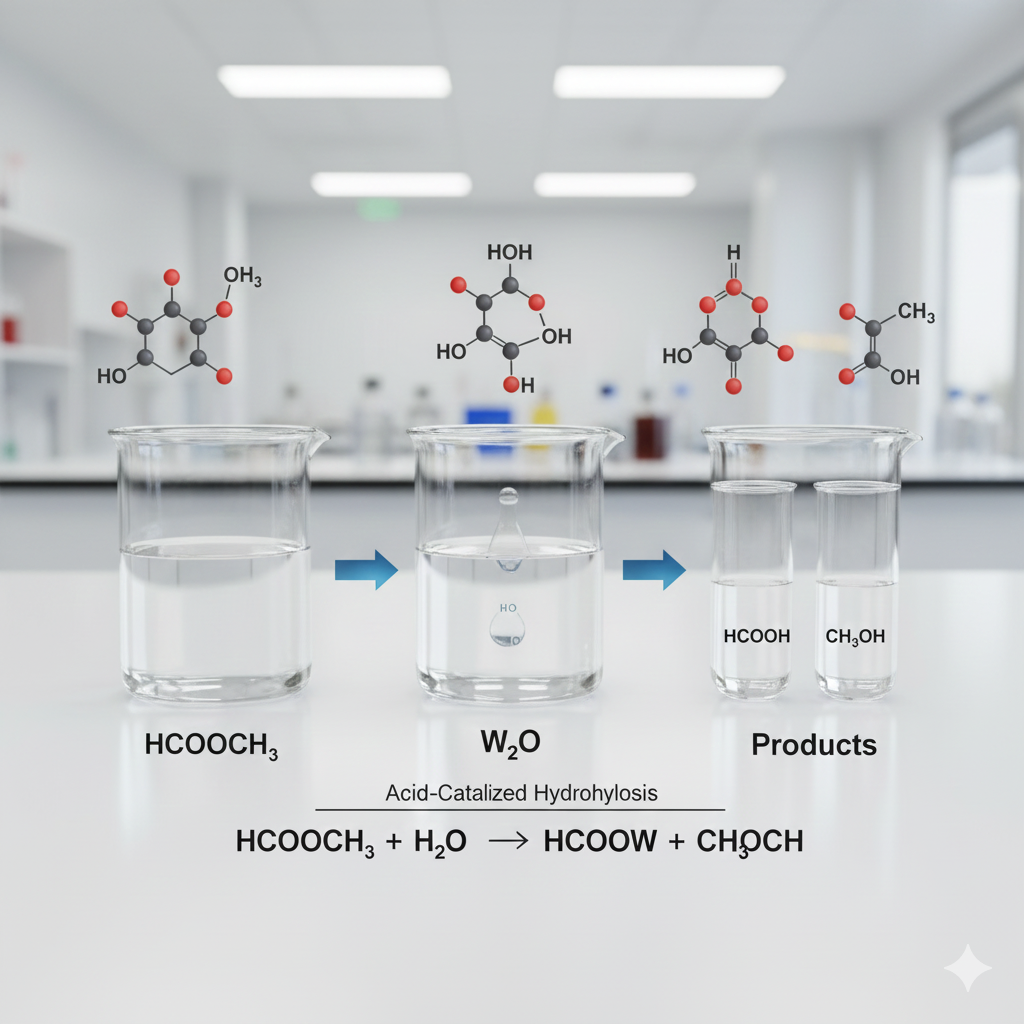
Chemically, the molecule is moderately reactive. The ester group can undergo hydrolysis, forming formic acid and alcohol derivatives. It’s soluble in water due to the presence of the H2O group, and it mixes fairly well with other polar solvents. In my experience, handling it is straightforward, but like with any reactive compound, proper ventilation and protective gear are essential.
Interestingly, despite being small, hcooch ch2 h2o can act in multiple ways depending on the reaction conditions. For example, under acidic conditions, it might break down slowly, whereas under basic conditions, it could react more quickly. This dual behavior makes it a favorite in certain synthetic applications.
Practical Applications: Where You Encounter It
You might be wondering, “Where would I actually see hcooch ch2 h2o in real life?” Well, it’s more common than you think. In organic synthesis, it’s often used as an intermediate, helping chemists create more complex molecules. Some industries use it in small-scale production of fragrances or flavor compounds because of its mild profile and reactivity.
Even in educational settings, molecules like this one are invaluable. In labs, students often perform reactions with esters to understand hydrolysis and substitution mechanisms. Working with hcooch ch2 h2o can give learners hands-on experience without exposing them to extreme hazards. I remember demonstrating a similar reaction to a group of students once; seeing the change before their eyes made the concept much easier to grasp.
Safety Considerations
No matter how benign a compound seems, safety is always a concern. Hcooch ch2 h2o is generally considered safe when handled properly, but it’s still a reactive chemical. You want to avoid direct inhalation of vapors and prevent skin contact if possible. Using gloves, goggles, and working in a well-ventilated area is a basic but necessary precaution.
One thing I always emphasize, especially to beginners, is that even small molecules can behave unpredictably under the wrong conditions. A little water, heat, or pH change can alter how hcooch ch2 h2o reacts, so careful observation is key. That’s part of the fun of chemistry—the balance between predictable behavior and slight surprises keeps you on your toes.
Common Misconceptions
I’ve noticed several misconceptions around hcooch ch2 h2o. Some people think it’s highly toxic or explosive because of the ester group. That’s not true. While it’s reactive in controlled conditions, it doesn’t pose extreme danger in typical laboratory or industrial settings. Others assume it’s a purely academic compound with no real-world application. In fact, its versatility makes it quite practical in certain synthesis and industrial processes.
Another misunderstanding is about its solubility. Because water is part of its structure, people assume it dissolves in any solvent, but solubility is more nuanced. Polar solvents work best, while non-polar solvents might not mix well. Observing this firsthand helps in planning reactions and avoiding failed experiments.
Hcooch Ch2 H2o in Everyday Contexts
It’s fascinating to consider how such a small molecule touches multiple aspects of our daily lives indirectly. While you won’t find hcooch ch2 h2o in your kitchen or bathroom, its derivatives and reaction products often make their way into consumer products. For instance, esters similar to the ones in this molecule can be found in fragrances, flavorings, and even in some biodegradable solvents.
From a personal viewpoint, I’ve always appreciated the elegance of small molecules like this. They may seem minor, but they form the foundation of much larger chemical knowledge. Working with hcooch ch2 h2o reminded me that chemistry is not just about reactions on paper—it’s about interactions that have real effects in industry and education alike.
Tips for Handling and Using Hcooch Ch2 H2o
If you’re planning to work with hcooch ch2 h2o, here are a few practical tips I’ve picked up:
- Storage: Keep it in a cool, dry place away from direct sunlight. Exposure to heat can accelerate decomposition.
- Mixing: Always add it slowly to other reagents. Even small volumes can react quickly under certain conditions.
- Observation: Pay attention to color changes, temperature shifts, or gas evolution. These indicate reactions are occurring.
- Disposal: Don’t pour it down the drain. Neutralize it properly before disposal to avoid environmental harm.
- Documentation: Keep a reaction log. You’ll thank yourself when you need to reproduce results or troubleshoot experiments.
Real-Life Experience: Lab Example
A few years ago, I was helping a student perform a simple ester hydrolysis experiment. We used hcooch ch2 h2o because it’s manageable yet clearly demonstrates reaction progress. Watching the reaction happen in real time, noticing the mild odor shift, and then seeing the formation of formic acid was a small but memorable experience. It’s little moments like these that show how a tiny molecule can teach big lessons.
FAQs About Hcooch Ch2 H2o
1. Is hcooch ch2 h2o dangerous to handle?
Not particularly. It’s reactive but safe under proper lab precautions like gloves and goggles.
2. Can hcooch ch2 h2o be used in food products?
Directly, no. But derivatives or related esters sometimes appear in flavoring and fragrance industries.
3. What solvents mix well with hcooch ch2 h2o?
Polar solvents like water, alcohols, or acetone work best due to the molecule’s polarity.
4. How is hcooch ch2 h2o made in the lab?
It’s typically formed from formic acid esters and methylene sources, often in controlled reactions with water present.
5. Why is hcooch ch2 h2o important for students?
It demonstrates basic principles of ester chemistry and reactivity in a hands-on, observable way.
Conclusion
While hcooch ch2 h2o may look simple on paper, its chemistry is both subtle and practical. From its structure to its applications in industry and education, it’s a small molecule with a lot to teach. Whether you’re a student, a chemist, or just curious, understanding its properties gives insight into the bigger picture of organic chemistry. It’s a reminder that even tiny molecules can play a meaningful role in science and learning.
Read Also